
Ask ten flower farmers how they price their stems and you’ll get ten different answers — and at least a few of them will end with “…honestly, I just guessed.”
Pricing is the hardest question in flower farming. Charge too little and you’re subsidizing florists with unpaid labour; charge too much and the sales stop coming. And unlike nearly every other crop, there’s no posted market price to check. The Dutch have their auction clock. Commodity growers have the futures board. Local flower farmers have… a Facebook group where someone in a different climate, with different costs, says “I get $3 a stem” and everyone quietly panics.
Let’s fix that; first with the classic pricing methods (still worth knowing), and then with something better: real numbers.
The classic approaches (and where they fall short)
Cost-plus. Add up what a stem costs to produce; seed or corm, amendmnts, irrigation, labour (yes, a real wage!), packaging, delivery — and multiply by two to three. This is the floor. If a formula ever tells you to sell below cost-plus, the formula is wrong or the crop is. The weakness: cost-plus tells you your minimum, not what the market will actually pay. Some stems command far more than 3× cost, and you’d never know.
Retail-back. Take the local retail price of a stem and halve it for wholesale. Reasonable sanity check, but retail prices bake in import logistics and supermarket loss-leaders, neither of which describes your dahlias.
Ask around. Valuable for relationships, terrible for data. You get one farm’s number, without knowing their quality, their market, or whether that price actually sells.
What every one of these methods is missing is the same thing: transparency. What are farms like yours actually charging?
What flowers actually sell for: real numbers
Florlist is the sales platform for local flower farms, and hundreds of farms list their wholesale prices on it. Aggregated and anonymized, that becomes something the local flower industry has never had — a genuine market report.
Here’s a sample of real per-stem wholesale pricing across popular crops as of July 2026 in USD:
| Flower | Low | Median | High |
|---|---|---|---|
| Peony | $1.50 | $3.00 | $7.60 |
| Dahlia | $0.83 | $2.50 | $6.00 |
| Lisianthus | $0.88 | $2.40 | $5.00 |
| Ranunculus | $0.70 | $2.00 | $5.00 |
| Snapdragon | $0.70 | $1.50 | $2.10 |
| Sunflower | $0.68 | $1.50 | $4.00 |
| Sweet Pea | $0.60 | $1.50 | $3.00 |
| Tulip | $0.80 | $1.49 | $3.50 |
| Zinnia | $0.50 | $1.20 | $3.00 |
| Cosmos | $0.42 | $1.00 | $2.00 |
Per-stem wholesale prices aggregated from farm listings on Florlist. Your region, quality, and season will move you within (and sometimes beyond) these ranges.
A few things jump out. The spread is enormous — the top dahlia growers charge seven times the bottom; of course this also represents specialty cultivars – and fortunately, Florlist does allow you to view cultivar-level dahlia data as well.
Specialty crops with real growing difficulty (peonies, lisianthus, dahlias) command clear premiums. And that $0.50 zinnia at the bottom of the range? Almost certainly underpriced — which is exactly the kind of thing you can only see with the distribution in front of you.
The live version: Florlist’s Market Report
Those numbers are a snapshot. Inside Florlist, the Market Report is live — real-time per-stem ranges and medians for the flowers farms are listing right now, updated as the market moves through the season.
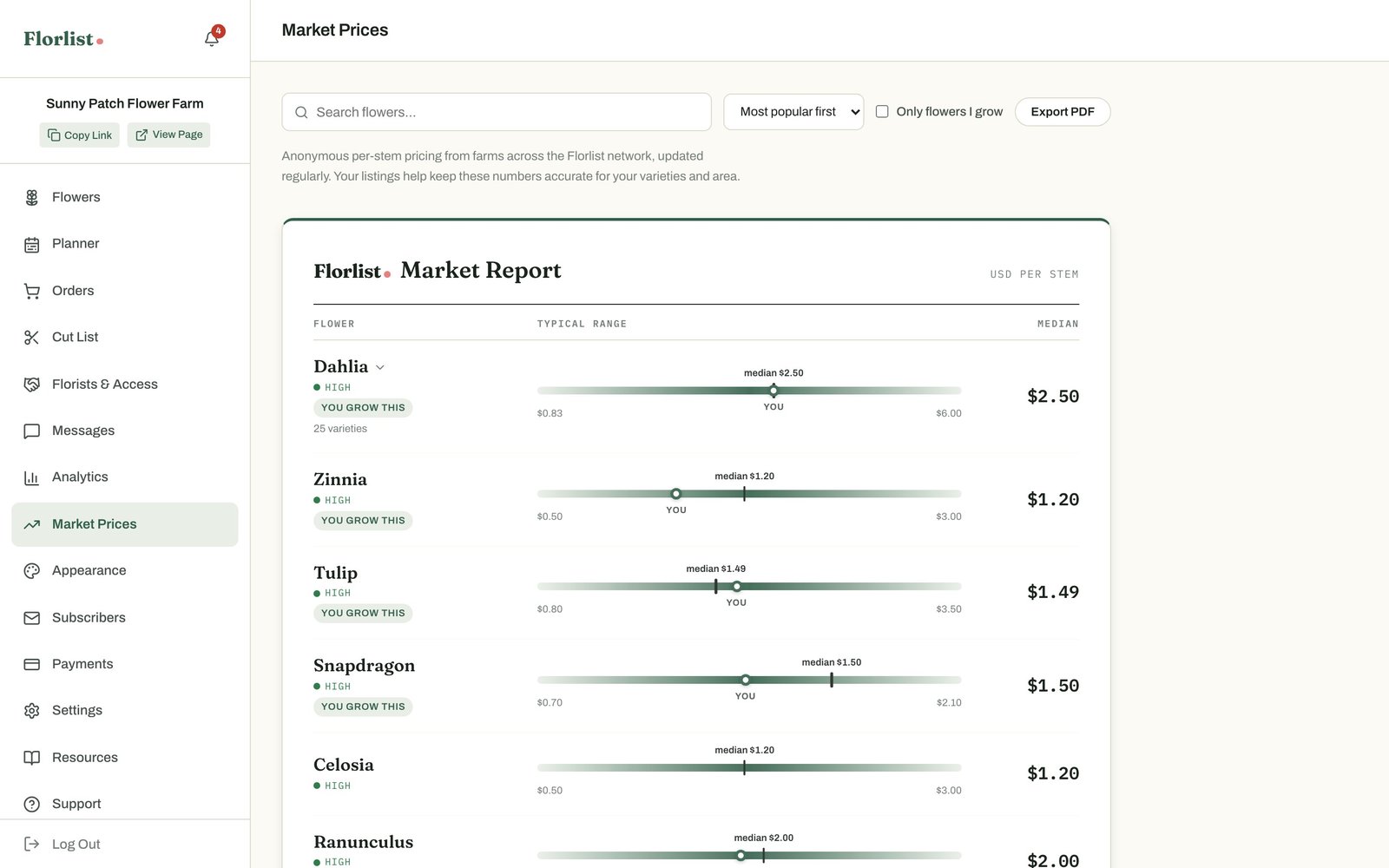
It works as an exchange: opt in to share your own prices (always anonymously, no farm names, ever) and you see everyone else’s. Hundreds of farms are already in.
How to actually use market data
- Anchor on the median, adjust for you. The median is what a typical farm charges. Exceptional quality, unusual varieties, or a high-cost market? Price above it, deliberately. New and building relationships? Slightly under — briefly.
- Let cost-plus set your floor. If the market median for a crop is below your cost-plus price, that’s not a pricing problem — it’s a crop-selection signal.
- Never race to the bottom. Undercutting doesn’t win florists; reliability and quality do. A florist who leaves you over 30 cents was never your customer.
- Watch the season. Tulips in April and tulips in June are different markets. The live report on Florlist moves with the calendar in a way no static chart can.
- Charge for what’s hard. The premium on peonies and lisianthus isn’t vanity — it’s compensation for corms, patience, and risk. If you grow the hard stuff, price like it.
See the live numbers
The Market Report is free, like everything else on Florlist — the platform where flower farms sell directly to local florists with a storefront, availability lists, and ordering built in.